Africa's pharmaceutical market is one of the world's most promising — and one of its most complex to navigate.
Sub-Saharan Africa represents a rapidly growing demand for quality medicines, driven by an expanding middle class, increasing disease burden, and governments under pressure to improve public health outcomes. The opportunity is real. But so are the obstacles. Regulatory systems remain deeply fragmented across borders. Institutional relationships take years to build. And the cost of entering without the right partners can far outweigh the potential gains.
At MednAfrica, we have spent years mapping these challenges from the inside — working alongside regulators, distributors, and health authorities across Senegal, the DRC, Gabon, and Burkina Faso. The barriers below are not abstractions for us. They are the problems we have learned to solve, one market at a time.
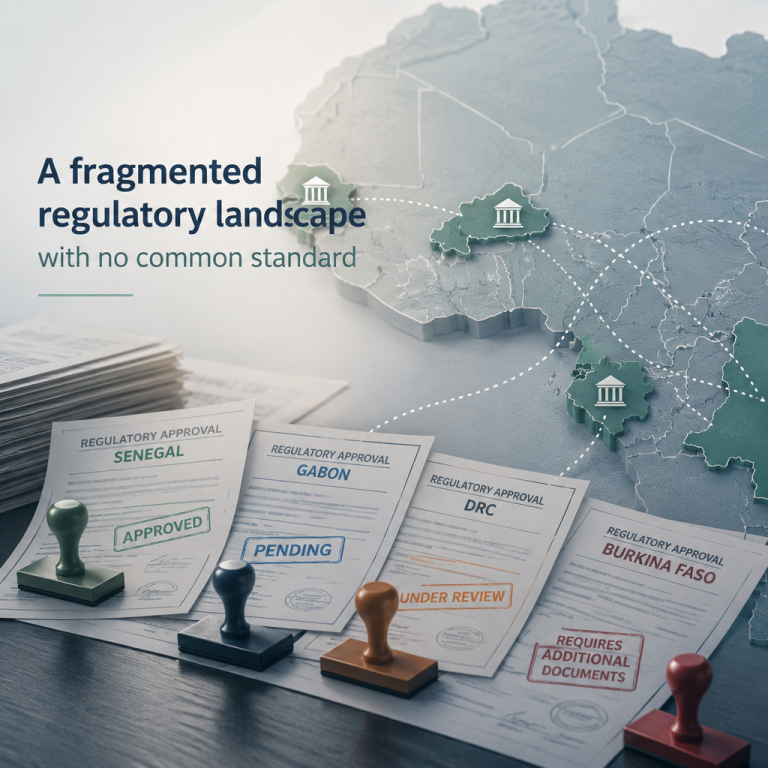
A fragmented regulatory landscape with no common standard
Across sub-Saharan Africa, each country maintains its own regulatory agency, its own approval procedures, and its own documentation requirements. A product cleared in Senegal must go through an entirely separate — and often unpredictable — process in Gabon, the DRC, or Burkina Faso. Timelines range from 6 months to over 3 years, with no regional harmonisation in sight for most markets.
This fragmentation creates a compounding burden for international laboratories: duplicated efforts, inconsistent standards, and the constant risk of market entry delays. For smaller manufacturers, the cost of navigating four or five separate regulatory systems can make Africa feel more like a liability than an opportunity.

High barriers to entry for foreign laboratories
Foreign pharmaceutical companies entering African markets face a wall of structural obstacles: mandatory local representation requirements, opaque tender processes, import licensing delays, and limited access to public procurement channels. Without local roots and institutional relationships built over years, even high-quality products struggle to find their way into hospital formularies or pharmacy networks.
Beyond the legal and administrative barriers, there is a cultural dimension that numbers alone cannot capture. Trust is built face-to-face, through sustained presence and demonstrated reliability. Foreign labs without established local credibility — no matter how strong their product portfolio — are routinely passed over in favour of better-connected regional players.



Finding credible, reliable local partners is harder than it looks
Selecting the right local distributor or regulatory partner is one of the most consequential decisions a laboratory makes when entering African markets — and one of the most difficult. The market is populated by intermediaries of vastly unequal quality: some with genuine networks and compliance infrastructure, others operating informally, with limited accountability and no track record of sustainable performance.
Vetting local partners requires deep market intelligence, language skills, institutional knowledge, and boots on the ground. A poorly chosen partner can damage a brand's reputation, create regulatory liabilities, or simply fail to deliver market penetration — wasting years of investment and closing doors that are hard to reopen.

Local promotion demands more than a translated brochure

Healthcare professionals in Dakar, Kinshasa, Libreville and Ouagadougou do not make prescribing decisions the same way their counterparts in Paris or Vienna do. Educational outreach, peer influence, and personal relationship-building with prescribers and pharmacists are the primary drivers of product adoption — not digital campaigns or printed sales materials.
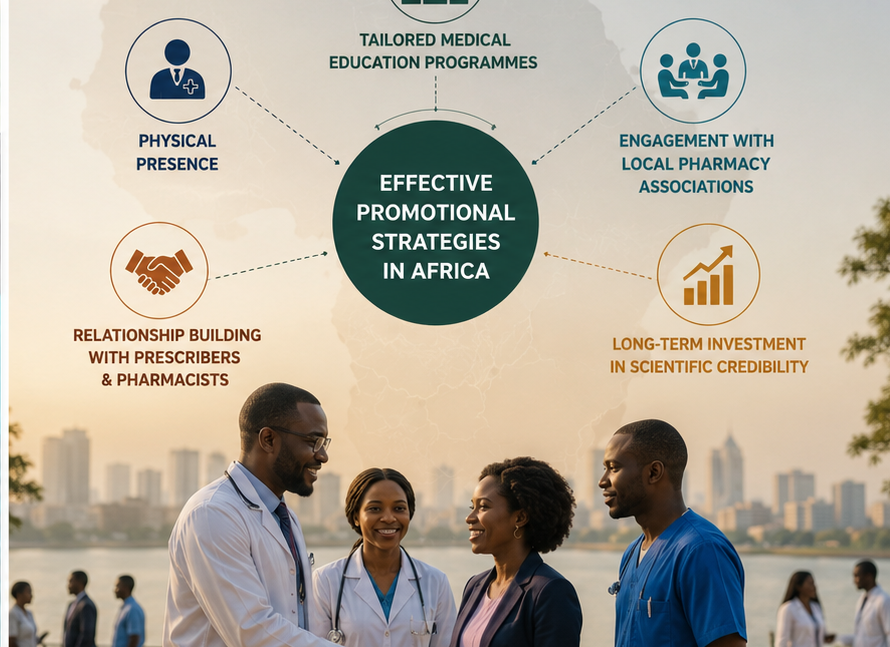
Effective promotional strategies in these markets require physical presence, tailored medical education programmes, engagement with local pharmacy associations, and long-term investment in building scientific credibility. Companies that approach African markets with a one-size-fits-all promotional model consistently underperform against those who adapt to local dynamics with patience and cultural intelligence.